Primary user
A PM-KISAN beneficiary who may use Hindi, an older phone or a slow connection and cannot easily interpret technical statuses.
Project submission
Paisa Kahan Hai is a bilingual, privacy-safe prototype for PM-KISAN beneficiaries with limited digital confidence—and the people who help them.
Project summary
PM-KISAN gives eligible farmer families ₹6,000 a year in three payments. If one does not arrive, the government's Know Your Status service requires a registration number, CAPTCHA and one-time password (OTP). The Kisan-eMitra AI chatbot answers questions about payments, registration and eligibility in several languages.
Paisa Kahan Hai adds a fixed workflow: it checks possible problems in a documented order and presents one first action.
It is an independent Hindi and English guide for farmers who are not comfortable with technology, and for the people helping them. It does not access government records or collect personal details. Users can try a fictional example or select status messages they already have.
The result gives the cause, office, items to carry, words to say, checked costs or timelines, verification and escalation. When a visit is needed, an identifier-free office note separates what to take from what to request there and what to confirm before leaving. The full guide can be read aloud, printed, saved as a PDF or shared. A WhatsApp-style preview offers the same checked journey one question at a time.
The latest PM-KISAN payment reached more than 9.44 crore farmers. Official data also records lakhs of stopped payments linked to land records, Aadhaar-bank linking and e-KYC. These figures show the problem's scale, not people helped by this prototype. All examples are fictional, and connection to government records has not been built.
A PM-KISAN beneficiary who may use Hindi, an older phone or a slow connection and cannot easily interpret technical statuses.
A family or community “phone person” helping the beneficiary decide what office to visit, what to carry and what to say.
Demo video
Feature focus: the office-ready first action. It turns a technical status into preparation before a visit, a request for the official or bank counter, and confirmations to obtain before leaving.
Previous demo — Round 2 replacement pendingThe new two-minute video will spend its second minute on the office-ready first action.
Open video directlyPerformance evidence
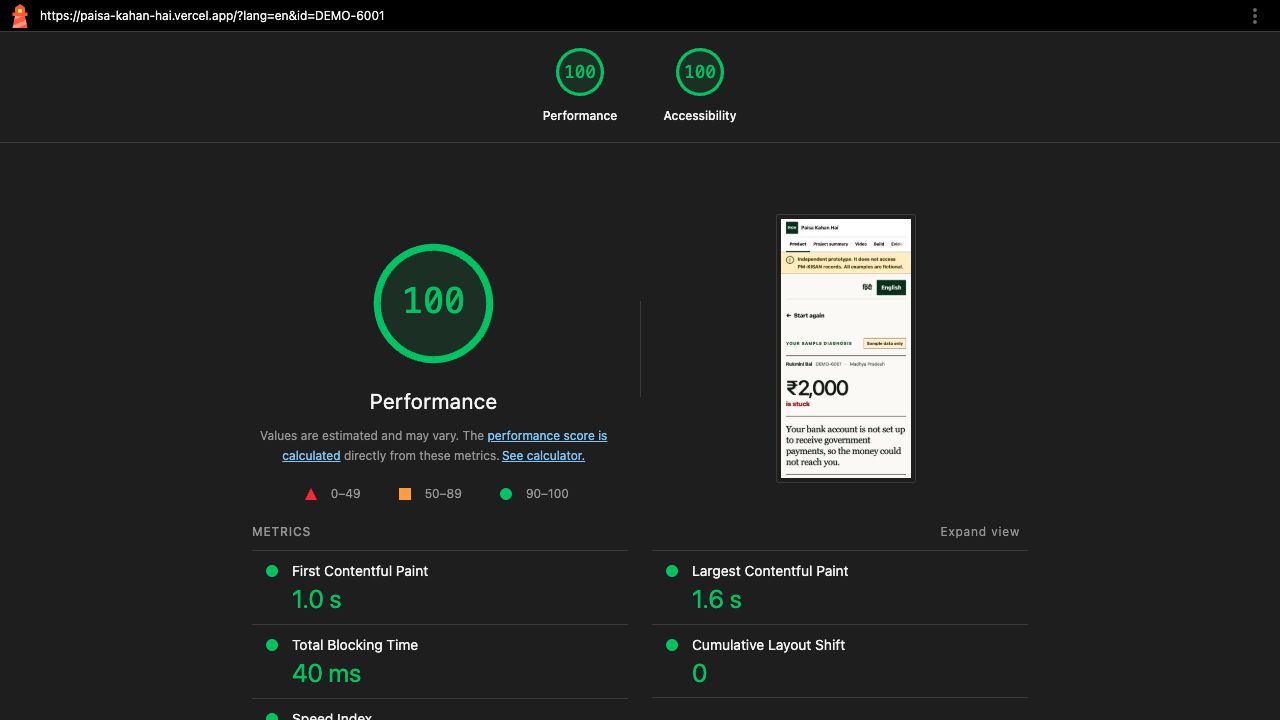
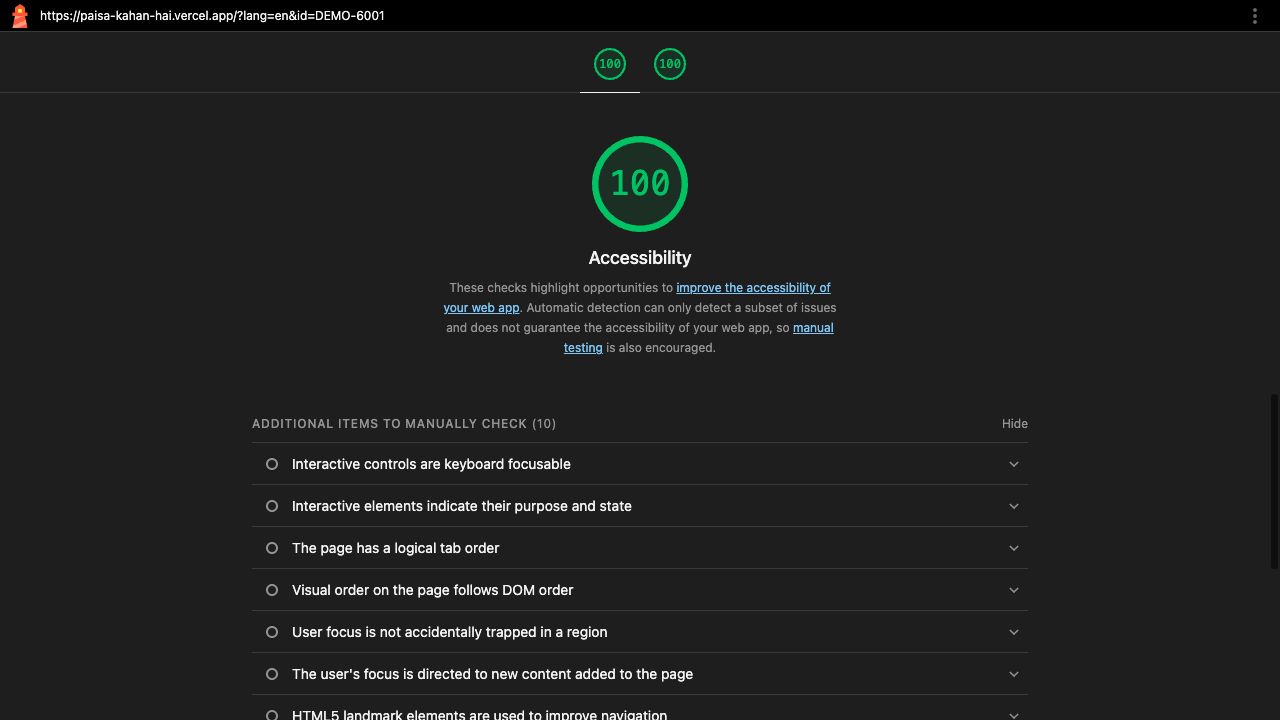
A dated Lighthouse capture records the earlier live release quality, while a fresh custom Slow-3G audit checks the current public Round 2 release under a stricter connection profile.
Largest Contentful Paint
Total Blocking Time
189,113 bytes across 12 requests
Method: Lighthouse 13.4.1 used the live production URL and its mobile profile on 26 August 2026. The current public release was measured on 5 September 2026 using 400 ms latency, 400 Kbps down/up and 4× CPU slowdown, with cache disabled.
Open the complete Lighthouse report ↗Honest limit: the current 189 KB first load is above this project's internal target of under 100 KB. The target remains recorded as not met.
Scale and potential impact
Official 2026 figures show both the scale of PM-KISAN and the number of records affected by mandatory-condition stoppages that this product is designed to explain.
These are problem-space figures, not people reached or outcomes created by Paisa Kahan Hai. The three stoppage categories may overlap and must not be added together as unique beneficiaries. Product reach and comprehension remain unmeasured.
Product / build
Try a fictional case, select statuses already known, or get help reaching the official status channel.
An ordered rules engine identifies the first blocker and sequences any later blockers.
The result gives one first action, the right office, documents, a counter script and escalation.
Technical status language
Uncertainty at the service counter
Hindi or assisted use
Older phones and slow data
Family or community help
High privacy consequence
Codex supported requirements, evidence reconciliation, architecture, implementation, bilingual review batches and QA. The builder directed the product and approved the Hindi; the rules engine—not an AI model—decides every result.
Evidence and validation
This validates the problem structure and product facts—not beneficiary comprehension or outcomes. No PM-KISAN beneficiary or frontline-worker study has been conducted.
End-to-end service thinking
This is a proposed safe path, not a claim that these integrations are available. The current prototype remains entirely outside government systems.
Minimal status contracts, versioned rules, source traceability, safe fallbacks and correction handling.
Encryption, strong authorisation, rate limits, audit logs, abuse monitoring, uptime and incident response.
Taxonomy maintenance, bank/CSC/agriculture-office routing, escalation, human support and service accountability.
Required dependencies are not confirmed capabilities: authorised data contracts, consent and identity standards, responsible system owners, operational support and a correction pathway would all need agreement before real-record use.
Transparency